

kinz :D
★komaeda nagito
karkat vantas
★bob (animal crossing)
ibuki mioda
gerard way
★kokichi ouma
osamu dazai
★dimitri alexandre blaiddyd
★bakugo katsuki
★sangwoo
kaworu nagisa
★awsten knight
★foxy
oikawa tooru
no doubles for starred characters. i am literally the irl reincarnate of them
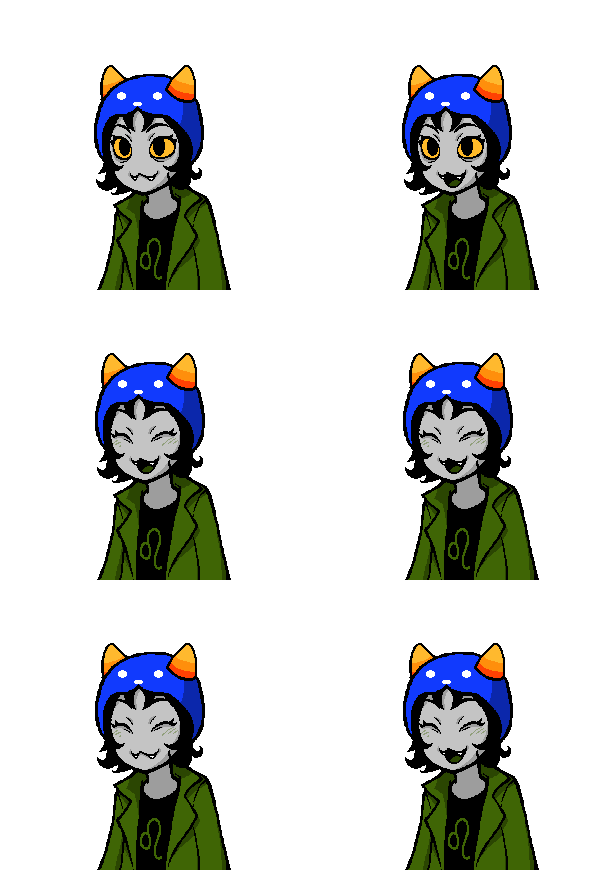

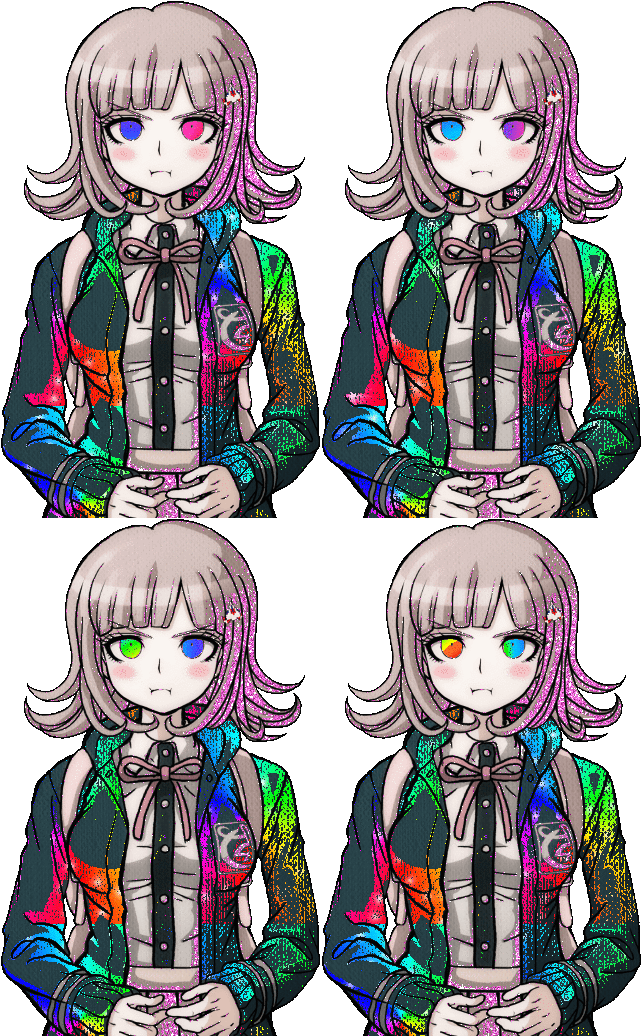
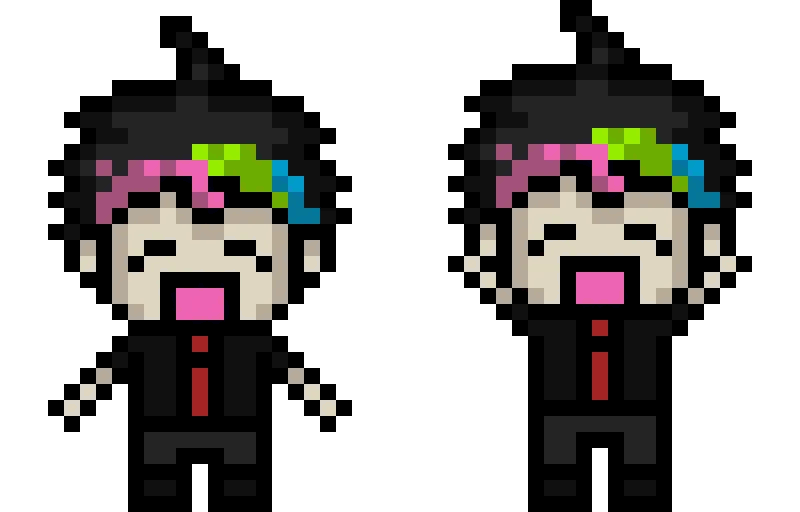
do not interact
-if you kin my starred characters
-if you dont support MAPS
-if you dont support he him lesbians
-if you dont like danganronpa
-if you are c*shet
-if you are skinny or average weight
-if you are white
-if you like pewdiepie

my name is awsten
i am 29
MAP rights
se / xir please
i live in kazakhstan
i am a prostitute
my onlyfans is fartmaster64
i am married to my wonderful husband kokichi
i'm vegan
FAFERWEFWAFRWGREAGRAEGREZAGRSDEGGSG
:)
Yugoslavia
From Wikipedia, the free encyclopedia
Jump to navigationJump to search
For the 1918–1941 kingdom, see Kingdom of Yugoslavia. For the 1945–1992 socialist federation, see Socialist Federal Republic of Yugoslavia. For the 1992–2006 federation and confederation between Montenegro and Serbia, see Serbia and Montenegro.
Yugoslavia
Jugoslavija
Југославија
1918–1941
1945–1992
1941–1945: Government-in-exile
Flag of Yugoslavia
Flag of Yugoslavia (1946-1992).svg
Top: Flag
(1918–1941)
Bottom: Flag
(1945–1992)
Coat of arms of the Kingdom of Yugoslavia.svg Emblem of the Socialist Federal Republic of Yugoslavia.svg
Top: Coat of arms
(1918–1941)
Bottom: Emblem
(1945–1992)
Anthem: "Himna Kraljevine Jugoslavije" (1919–1941)
MENU0:00
"Hej, Slaveni" (1945–1992)
MENU0:00
Yugoslavia during the Interwar period and the Cold War
Yugoslavia during the Interwar period and the Cold War
Capital
and largest city
Belgrade
44°49′N 20°27′ECoordinates: 44°49′N 20°27′E
Official languages Serbo-Croatian
Macedonian
Slovene
Demonym(s) Yugoslav
Government Monarchy (1918–1941)
Socialist republic (1945–1992)
Details[show]
Historical era 20th century
• Creation
1 December 1918
• Axis invasion
6 April 1941
• Admitted to the UN
24 October 1945
• Abolition of monarchy
29 November 1945
• Disintegration
27 April 1992
Currency Yugoslav dinar
Calling code 38
Internet TLD .yu
Preceded by Succeeded by
Serbia
Montenegro
State of Slovenes, Croats and Serbs
Kingdom of Hungary
Fiume
Croatia
Slovenia
Macedonia
Bosnia and Herzegovina
Serbia and Montenegro
Today part of Bosnia and Herzegovina
North Macedonia
Serbia
Slovenia
Yugoslavia (/ˌjuːɡoʊˈslɑːviə/; Serbo-Croatian: Jugoslavija / Југославија [juɡǒslaːʋija]; Slovene: Jugoslavija [juɡɔˈslàːʋija]; Macedonian: Југославија [juɡɔˈsɫavija];[A] lit. '"Southern Slav Land"') was a country in Southeastern and Central Europe for most of the 20th century. It came into existence after World War I in 1918[B] under the name of the Kingdom of Serbs, Croats and Slovenes by the merger of the provisional State of Slovenes, Croats and Serbs (it was formed from territories of the former Austro-Hungarian Empire) with the Kingdom of Serbia, and constituted the first union of the South Slavic people as a sovereign state, following centuries in which the region had been part of the Ottoman Empire and Austria-Hungary. Peter I of Serbia was its first sovereign. The kingdom gained international recognition on 13 July 1922 at the Conference of Ambassadors in Paris.[2] The official name of the state was changed to Kingdom of Yugoslavia on 3 October 1929.
Yugoslavia was invaded by the Axis powers on 6 April 1941. In 1943, a Democratic Federal Yugoslavia was proclaimed by the Partisan resistance. In 1944 King Peter II, then living in exile, recognised it as the legitimate government. The monarchy was subsequently abolished in November 1945. Yugoslavia was renamed the Federal People's Republic of Yugoslavia in 1946, when a communist government was established. It acquired the territories of Istria, Rijeka, and Zadar from Italy. Partisan leader Josip Broz Tito ruled the country as president until his death in 1980. In 1963, the country was renamed again, as the Socialist Federal Republic of Yugoslavia (SFRY).
The six constituent republics that made up the SFRY were the SR Bosnia and Herzegovina, SR Croatia, SR Macedonia, SR Montenegro, SR Serbia, and SR Slovenia. Serbia contained two Socialist Autonomous Provinces, Vojvodina and Kosovo, which after 1974 were largely equal to the other members of the federation.[3][4] After an economic and political crisis in the 1980s and the rise of nationalism, Yugoslavia broke up along its republics' borders, at first into five countries, leading to the Yugoslav Wars. From 1993 to 2017, the International Criminal Tribunal for the former Yugoslavia tried political and military leaders from the former Yugoslavia for war crimes, genocide, and other crimes committed during those wars.
After the breakup, the republics of Montenegro and Serbia formed a reduced federative state, Serbia and Montenegro, known officially until 2003 as the Federal Republic of Yugoslavia (FRY). This state aspired to the status of sole legal successor to the SFRY, but those claims were ohe other former republics. Eventually, it accepted the opinion of the Badinter Arbitration Committee about shared succession[5] and in 2003 its official name was changed to Serbia and Montenegro. This state dissolved when Montenegro and Serbia each became independent states in 2006, while Kosovo proclaimed its independence from Serbia in 2008.
Contents
1 Background
2 Kingdom of Yugoslavia
2.1 King Alexander
2.2 1934–1941
3 World War II
4 FPR Yugoslavia
4.1 The 1948 Yugoslavia–Soviet split
5 SFR Yugoslavia
5.1 Ethnic tensions and economic crisis
6 Breakup
6.1 Yugoslav Wars
6.2 Timeline
7 New states
7.1 Succession, 1992–2003
7.2 Succession, 2006–present
7.3 Yugosphere
8 Demographics
9 See also
10 Notes
11 References
12 Further reading
13 External links
Background
Main article: Creation of Yugoslavia
The concept of Yugoslavia, as a single state for all South Slavic peoples, emerged in the late 17th century and gained prominence through the Illyrian Movement of the 19th century. The name was created by the combination of the Slavic words "jug" (south) and "slaveni" (Slavs). Yugoslavia was the result of the Corfu Declaration, as a project of the Serbian Parliament in exile and the Serbian royal Karađorđević dynasty, who became the Yugoslav royal dynasty.
Kingdom of Yugoslavia
Main article: Kingdom of Yugoslavia
Banovinas of Yugoslavia, 1929–39. After 1939 the Sava and Littoral banovinas were merged into the Banovina of Croatia.
The country was formed in 1918 immediately after World War I as the Kingdom of Serbs, Croats and Slovenes by union of the State of Slovenes, Croats and Serbs and the Kingdom of Serbia. It was commonly referred to at the time as the "Versailles state". Later, the government renamed the country leading to the first official use of Yugoslavia in 1929.
King Alexander
On 20 June 1928, Serb deputy Puniša Račić shot at five members of the opposition Croatian Peasant Party in the National Assembly resulting in the death of two deputies on the spot and that of leader Stjepan Radić a few weeks later.[6] On 6 January 1929, King Alexander I suspended the constitution, banned national political parties, assumed executive power and renamed the country Yugoslavia.[7] He hoped to curb separatist tendencies and mitigate nationalist passions. He imposed a new constitution and relinquished his dictatorship in 1931.[8] However, Alexander's policies later encountered opposition from other European powers stemming from developments in Italy and Germany, where Fascists and Nazis rose to power, and the Soviet Union, where Joseph Stalin became absolute ruler. None of these three regimes favored the policy pursued by Alexander I. In fact, Italy and Germany wanted to revise the international treaties signed after World War I, and the Soviets were determined to regain their positions in Europe and pursue a more active international policy.
Alexander attempted to create a centralised Yugoslavia. He decided to abolish Yugoslavia's historic regions, and new internal boundaries were drawn for provinces or banovinas. The banovinas were named after rivers. Many politicians were jailed or kept under police surveillance. The effect of Alexander's dictatorship was to further alienate the non-Serbs from the idea of unity.[9] During his reign the flags of Yugoslav nations were banned. Communist ideas were banned also.
The king was assassinated in Marseille during an official visit to France in 1934 by Vlado Chernozemski, an experienced marksman from Ivan Mihailov's Internal Macedonian Revolutionary Organization with the cooperation of the Ustaše, a Croatian fascist revolutionary organisation. Alexander was succeeded by his eleven-year-old son Peter II and a regency council headed by his cousin, Prince Paul.
1934–1941
The international political scene in the late 1930s was marked by growing intolerance between the principal figures, by the aggressive attitude of the totalitarian regimes and by the certainty that the order set up after World War I was losing its strongholds and its sponsors were losing their strength. Supported and pressured by Fascist Italy and Nazi Germany, Croatian leader Vladko Maček and his party managed the creation of the Banovina of Croatia (Autonomous Region with significant internal self-government) in 1939. The agreement specified that Croatia was to remain part of Yugoslavia, but it was hurriedly building an independent political identity in international relations. The entire kingdom was to be federalised but World War II stopped the fulfillment of those plans.
Prince Paul submitted to the fascist pressure and signed the Tripartite Pact in Vienna on 25 March 1941, hoping to still keep Yugoslavia out of the war. But this was at the expense of popular support for Paul's regency. Senior military officers were also opposed to the treaty and launched a coup d'état when the king returned on 27 March. Army General Dušan Simović seized power, arrested the Vienna delegation, exiled Paul, and ended the regency, giving 17-year-old King Peter full powers. Hitler then decided to attack Yugoslavia on 6 April 1941, followed immediately by an invasion of Greece where Mussolini had previously been repelled.[10]
World War II
This section needs additional citations for verification. Please help improve this article by adding citations to reliable sources. Unsourced material may be challenged and removed.
Find sources: "Yugoslavia" – news · newspapers · books · scholar · JSTOR (May 2018) (Learn how and when to remove this template message)
Main article: World War II in Yugoslavia
Partisan Stjepan Filipović shouting "Death to fascism, freedom to the people!" shortly before his execution
At 5:12 AM on 6 April 1941, German, Italian and Hungarian forces invaded Yugoslavia.[11] The German Air Force (Luftwaffe) bombed Belgrade and other major Yugoslav cities. On 17 April, representatives of Yugoslavia's various regions signed an armistice with Germany in Belgrade, ending eleven days of resistance against the invading German forces.[12] More than 300,000 Yugoslav officers and soldiers were taken prisoner.[13]
The Axis Powers occupied Yugoslavia and split it up. The Independent State of Croatia was established as a Nazi satellite state, ruled by the fascist militia known as the Ustaše that came into existence in 1929, but was relatively limited in its activities until 1941. German troops occupied Bosnia and Herzegovina as well as part of Serbia and Slovenia, while other parts of the country were occupied by Bulgaria, Hungary, and Italy. From 1941–45, the Croatian Ustaše regime murdered around 500,000 people, 250,000 were expelled, and another 200,000 were forced to convert to Catholicism.
From the start, the Yugoslav resistance forces consisted of two factions: the communist-led Yugoslav Partisans and the royalist Chetniks, with the former receiving Allied recognition only at the Tehran conference (1943). The heavily pro-Serbian Chetniks were led by Draža Mihajlović, while the pan-Yugoslav oriented Partisans were led by Josip Broz Tito.
The Partisans initiated a guerrilla campaign that developed into the largest resistance army in occupied Western and Central Europe. The Chetniks were initially supported by the exiled royal government and the Allies, but they soon focused increasingly on combating the Partisans rather than the occupying Axis forces. By the end of the war, the Chetnik movement transformed into a collaborationist Serb nationalist militia completely dependent on Axis supplies.[14] The highly mobile Partisans, however, carried on their guerrilla warfare with great success. Most notable of the victories against the occupying forces were the battles of Neretva and Sutjeska.
On 25 November 1942, the Anti-Fascist Council of National Liberation of Yugoslavia was convened in Bihać, modern day Bosnia and Herzegovina. The council reconvened on 29 November 1943, in Jajce, also in Bosnia and Herzegovina, and established the basis for post-war organisation of the country, establishing a federation (this date was celebrated as Republic Day after the war).
The Yugoslav Partisans were able to expel the Axis from Serbia in 1944 and the rest of Yugoslavia in 1945. The Red Army provided limited assistance with the liberation of Belgrade and withdrew after the war was over. In May 1945, the Partisans met with Allied forces outside former Yugoslav borders, after also taking over Trieste and parts of the southern Austrian provinces of Styria and Carinthia. However, the Partisans withdrew from Trieste in June of the same year under heavy pressure from Stalin, who did not want a confrontation with the other Allies.
Western attempts to reunite the Partisans, who denied the supremacy of the old government of the Kingdom of Yugoslavia, and the émigrés loyal to the king led to the Tito-Šubašić Agreement in June 1944; however, Marshal Josip Broz Tito was in control and was determined to lead an independent communist state, starting as a prime minister. He had the support of Moscow and London and led by far the strongest partisan force with 800,000 men.[15][16]
The official Yugoslav post-war estimate of victims in Yugoslavia during World War II is 1,704,000. Subsequent data gathering in the 1980s by historians Vladimir Žerjavić and Bogoljub Kočović showed that the actual number of dead was about 1 million.
FPR Yugoslavia
Main article: Federal People's Republic of Yugoslavia
On 11 November 1945, elections were held with only the Communist-led National Front appearing on the ballot, securing all 354 seats. On 29 November, while still in exile, King Peter II was deposed by Yugoslavia's Constituent Assembly, and the Federal People's Republic of Yugoslavia was declared.[17] However, he refused to abdicate. Marshal Tito was now in full control, and all opposition elements were eliminated.[18]
On 31 January 1946, the new constitution of Federal People's Republic of Yugoslavia, modelled after the Soviet Union, established six republics, an autonomous province, and an autonomous district that were part of SR Serbia. The federal capital was Belgrade. The policy focused on a strong central government under the control of the Communist Party, and on recognition of the multiple nationalities.[18] The flags of the republics used versions of the red flag or Slavic tricolor, with a red star in the centre or in the canton.
Name Capital Flag Coat of arms Location
Socialist Republic of Bosnia and Herzegovina Sarajevo
Flag of Bosnia and Herzegovina (1946–1992).svg
Coat of Arms of the Socialist Republic of Bosnia and Herzegovina.svg
SR SloveniaSR CroatiaSR Bosnia and
HerzegovinaSR
MontenegroSR MacedoniaSR SerbiaSAP
VojvodinaSAP
Kosovo
Socialist Republic of Croatia Zagreb
Flag of Croatia (1947–1990).svg
Coat of Arms of the Socialist Republic of Croatia.svg
Socialist Republic of Macedonia Skopje
Flag of the Socialist Republic of Macedonia (1963–1991).svg
Coat of arms of Macedonia (1946–2009).svg
Socialist Republic of Montenegro Titograd
Flag of Montenegro (1946–1993).svg
Coat of arms of Montenegro (1945–1994).svg
Socialist Republic of Serbia
SAP Kosovo
SAP Vojvodina
Belgrade
Priština
Novi Sad
Flag of Serbia (1947–1992).svg
Coat of arms of Serbia (1947–2004).svg
Socialist Republic of Slovenia Ljubljana
Flag of Slovenia (1945–1991).svg
Coat of Arms of the Socialist Republic of Slovenia.svg
Tito's regional goal was to expand south and take control of Albania and parts of Greece. In 1947, negotiations between Yugoslavia and Bulgaria led to the Bled agreement, which proposed to form a close relationship between the two Communist countries, and enable Yugoslavia to start a civil war in Greece and use Albania and Bulgaria as bases. Stalin vetoed this agreement and it was never realised. The break between Belgrade and Moscow was now imminent.19
Yugoslavia solved the national issue of nations and nationalities (national minorities) in a way that all nations and nationalities had the same rights. However, most of the German minority of Yugoslavia, most of whom had collaborat
Hello
Hi
Samsung 36 Inch Wide 27.9 Cu. Ft. Energy Star Rated French 4-Door Refrigerator with SmartThings Features
Model: RF28N9780SG


The third impact will
be real in
Anyone else here gay and horny?
You sick fuck
I got in a fight, I was indisposed
I was in, despite all the wicked prose
But I'm only a man
And I do what I can
I got friends in high places, I get out for free
I got in a fight, but they don't know me
'Cause I'm only a man
And I do what I can
B-E-H-A-V-E
Arrest us
Italiana mobster
Looking so precious
B-E-H-A-V-E
Never more
You gave up being good when you declared a state of war!
Eh I don't behave, I don't behave, oh eh
I don't behave, I don't behave, oh eh
I don't behave, I don't behave, oh
Are you going to the party? Are you going to the show?
'Cause I'm only a man, do what I can, oh
'Cause I'm only a man, do what I can
Are you going to the party? Are you going to the show?
I did something bad, maybe I was wrong
Sometimes people say that I'm a big time bomb
But I'm only a man
And I do what I can
B-E-H-A-V-E
Arrest us
Italiana mobster
Looking so precious
B-E-H-A-V-E
Never more
You gave up being good when you declared a state of war
Eh I don't behave, I don't behave, oh eh
I don't behave, I don't behave, oh eh
I don't behave, I don't behave, oh
Are you going to the party? Are you going to the show?
'Cause I'm only a man, do what I can, oh
'Cause I'm only a man, do what I can
Are you going to the party? Are you going to the show?
Oh, whoa, o, whoa
The fire it's alright
'Cause we can make 'em all go crazy
We can make 'em wanna die
Oh, whoa, oh, whoa
The fire it's alright
The people touch it
I can't touch, even though it's mine
Eh I don't behave, I don't behave, oh eh
I don't behave, I don't behave, oh eh
I don't behave, I don't behave, oh
Are you going to the party? Are you going to the show?
'Cause I'm only a man, do what I can, oh
'Cause I'm only a man, do what I can
B-E-H-A-V-E
Arrest us
Italiana mobster
Looking so precious
B-E-H-A-V-E
Never more
You gave up being good when you declared a state of war
Text